Overview of the Junk Email Filter
No one likes spam or junk email. The Outlook Junk Email Filter doesn’t stop delivery of junk email messages, but does the next best thing—it moves suspected spam to the Junk Email folder.
Note: These steps are not applicable to new Outlook for Windows. Check to see if the new Outlook toggle is turned on or off. If it’s on, please go to Filter junk email and spam in Outlook.
Tips: It’s a good idea to regularly review messages in the Junk Email folder to check for legitimate messages that were incorrectly classified as junk. If you find a message that isn’t junk, drag it back to the Inbox or any folder. You can also mark the item as not junk by doing the following:
Click Home > Junk > Not Junk.
By default, the Junk Email Filter is turned on and the protection level is set to No Automatic Filtering. You can make the filter more aggressive by changing the level of protection that it provides. The Junk Email Filter evaluates each incoming message based on several factors. These can include the time when the message was sent and the content of the message.
To change the options for the Junk Email Filter, do the following:
Click Home > Junk > Junk Email Options.
Junk email filter lists
While the Junk Email Filter checks your incoming messages automatically, Junk Email Filter Lists let you control what is considered spam. You can add names, email addresses and domains to these lists so the filter doesn’t check messages from sources you trust, or blocks messages that arrive from specific email addresses and domains you don’t know or trust.
Safe Senders list Email addresses and domain names in the Safe Senders List are never treated as junk email, regardless of the content of the message. You can add your Contacts and other correspondents to this list. However, by design, safe domains are not recognized by default in Exchange Online or in Exchange Online Protection. Only blocked domains, blocked sender addresses, and safe sender addresses are recognized. If you use a Microsoft Exchange Server account, all names and addresses in the global address list (GAL) are automatically considered safe. The Safe Sender limit is 1024.
Safe Recipients list If you belong to a mailing list or a distribution list, you can add the list sender to the Safe Recipients List. Messages sent to these email addresses or domain names are never treated as junk, regardless of the content of the message.
Blocked Senders list You can easily block messages from particular senders by adding their email addresses or domain names to the Blocked Senders List. When you add a name or email address to this list, Outlook moves any incoming message from that source to the Junk Email folder. Messages from people or domain names that appear in this list are always classified as junk, regardless of the content of the message.
Blocked Top-Level Domains list To block unwanted email messages from another country/region, you can add country/region codes to the Blocked Top-Level Domains List. For example, checking the CA [Canada], US [United States], and MX [Mexico] boxes in the list blocks messages from email addresses that end in .ca, .us, and .mx.
Blocked Encodings list To block unwanted email messages that appear in another character set or alphabet, you can add encodings to the Blocked Encodings List.
Junk Email Filter differences when Cached Exchange Mode is turned on or off
If you use an Exchange account, you have access to another layer of tools to combat junk email.
If you use Cached Exchange Mode or download to an Outlook data file (.pst) The Junk Email Filter Lists are saved on the server and are available from any computer. The filter lists are also used by the server to evaluate messages. This means that if a sender appears in your Blocked Senders List, then messages from that sender are moved to the Junk Email folder on the server, and they aren’t evaluated by Outlook.
If you work online The Junk Email Filter Lists are saved on the server. They are available from any computer, but only if you have the Junk Email feature enabled in Outlook Web Access or Outlook Web App. The filter lists are also used by the server to evaluate messages. This means that if a sender appears in your Blocked Senders List, then messages from that sender are moved to the Junk Email folder on the server, and they aren’t evaluated by Outlook.
How the Junk Email Filter works
The Junk Email Filter evaluates each incoming message to assess whether it might be spam, based on several factors. These can include the time when the message was sent and the content of the message. By default, the Junk Email Filter is turned on and the protection level is set to Low. This level catches only the most obvious spam. You can make the filter more aggressive by changing the level of protection that it provides.
Note: The Outlook Junk Email Filter doesn’t stop delivery of junk email messages, but moves suspected spam to the Junk E-mail folder.
You can adjust the Junk Email Filter settings in the Junk E-mail Options dialog box.
On the Home tab, in the Delete group, click Junk, and then click Junk E-mail Options.
Junk E-mail folder
Any message that is suspected to be junk is moved to the Junk E-mail folder. We recommend that you periodically review the messages in the Junk E-mail folder to check for legitimate messages that were incorrectly classified as junk. If you find a message that isn’t junk, drag them back to the Inbox or to any folder. You can also mark the item as not junk by doing the following:
On the Home tab, in the Delete group, click Junk, and then click Not Junk.
Junk Email Filter Lists
While the Junk Email Filter checks your incoming messages automatically, the Junk Email Filter Lists give you more control over what is considered spam. You can add names, email addresses and domains to these lists so the Filter allows for messages from sources that you trust, or blocks messages that arrive from specific email addresses and domains that you don’t know or trust.
Safe Senders List Email addresses and domain names in the Safe Senders List are never treated as junk email, regardless of the content of the message. You can add your Contacts and other correspondents to this list. However, by design, safe domains are not recognized by default in Exchange Online or in Exchange Online Protection. Only blocked domains, blocked sender addresses, and safe sender addresses are recognized. If you use a Microsoft Exchange Server account, all names and addresses in the global address list (GAL) are automatically considered safe.
Safe Recipients List If you belong to a mailing list or a distribution list, you can add the list sender to the Safe Recipients List. Messages sent to these email addresses or domain names are never treated as junk, regardless of the content of the message.
Blocked Senders List You can easily block messages from particular senders by adding their email addresses or domain names to the Blocked Senders List. When you add a name or email address to this list, Outlook moves any incoming message from that source to the Junk E-mail folder. Messages from people or domain names that appear in this list are always classified as junk, regardless of the content of the message.
Blocked Top-Level Domains List To block unwanted email messages that come from another country/region, you can add country/region codes to the Blocked Top-Level Domains List. For example, selecting the CA [Canada], US [United States], and MX [Mexico] check boxes in the list would block messages from email addresses that end in .ca, .us, and .mx.
Blocked Encodings List To block unwanted email messages that appear in another character set or alphabet, you can add encodings to the Blocked Encodings List.
Email account types supported by the Junk Email Filter
The Junk Email Filter can be used with the following kinds of email accounts:
Exchange accounts in Cached Exchange Mode
Exchange account that delivers to an Outlook Data File (.pst)
Outlook Connector for Outlook.com (formerly Hotmail)
Microsoft Outlook Connector for IBM Lotus Domino
If you want to change your profile, export a copy of the Junk Email Lists before you make the changes, and then import the information into Outlook. This makes sure that you won’t have to re-create the Junk Email Filter Lists.
Junk Email Filter differences when Cached Exchange Mode is turned on or off
If you use an Exchange account, you have access to another layer of capabilities and tools to combat junk email.
If you use Cached Exchange Mode or download to an Outlook Data File (.pst) The Junk Email Filter Lists are saved on the server and are available from any computer. The filter lists are also used by the server to evaluate messages. This means that if a sender appears in your Blocked Senders List, then messages from that sender are moved to the Junk E-mail folder on the server, and they aren’t evaluated by Outlook.
If you work online The Junk Email Filter Lists are saved on the server. They are available from any computer, but only if you have the Junk Email feature enabled in Outlook Web Access or Outlook Web App. The filter lists are also used by the server to evaluate messages. This means that if a sender appears in your Blocked Senders List, then messages from that sender are moved to the Junk E-mail folder on the server, and they aren’t evaluated by Outlook.
How the Junk E-mail Filter works
The Junk E-mail Filter evaluates each incoming message to assess whether it may be spam, based on several factors. These can include the time when the message was sent and the content of the message. By default, the Junk E-mail Filter is turned on and the protection level is set to Low. This level catches only the most obvious spam. You can make the filter more aggressive by changing the level of protection. Also, the Junk E-mail Filter can be updated periodically to protect against the latest techniques that spammers use to spam your Inbox.
Note: The Outlook Junk E-mail Filter does not stop junk e-mail from being delivered, but rather diverts suspected spam to your Junk E-mail folder instead of your inbox. Some third-party solutions are available which can be more aggressive on this front.
Tip: You can control many of your Junk E-mail Filter settings with the Junk E-mail Options dialog box. From your Inbox, in the Actions menu, point to Junk E-mail and then click Junk E-mail Options.
Junk E-mail folder
Any message that is caught by the Junk E-mail Filter is moved to a special Junk E-mail folder. It is a good idea to review the messages in the Junk E-mail folder periodically to make sure that they are not legitimate messages that you want to see. If they are legitimate, you can move them back to the Inbox by marking them as not junk. You can also drag them to any folder.
Junk E-mail Filter Lists
Even though the Junk E-mail Filter filters your incoming messages automatically, the Junk E-mail Filter Lists enable you more control over what is or is not considered spam. These lists enable you to allow messages from sources that you trust, or block messages that arrive from specific e-mail addresses and domains that you don’t know or trust.
There are five Junk E-mail Filter lists
Safe Senders List
Safe Recipients List
Blocked Senders List
International — Blocked Top-Level Domains List
International — Blocked Encodings List
Safe Senders List
If the filter mistakenly marks an e-mail message as a junk e-mail message, you can Block a mail sender. You can also manually build your Safe Senders list in the Junk E-mail Options dialog box. E-mail addresses and domain names in the Safe Senders List are never treated as junk e-mail, regardless of the content of the message. However, by design, safe domains are not recognized by default in Exchange Online or in Exchange Online Protection. Only blocked domains, blocked sender addresses, and safe sender addresses are recognized.
All of the e-mail addresses in your Contacts are included in this list if the Also trust e-mail from my Contacts check box in Junk E-mail Options is selected (the default setting). With this setting, messages from people in your Contacts folder will never be treated as junk e-mail messages.
E-mail addresses of people who are not listed in your Contacts but with whom you correspond are included in this list if you select the Automatically add people I e-mail to the Safe Senders List check box. (This check box is not selected by default.)
A recipient’s e-mail address is saved in the list by default only when you create and send a message manually in Outlook, instead of the message being generated automatically by a program.
Personal distribution lists cannot be added by using this check box.
If you accidentally reply to a spammer’s e-mail message (for example, by sending a request to unsubscribe from the spammer’s mailing list) while this check box is selected, that spammer’s e-mail address will be added to the Safe Senders List. If you later notice the spammer’s messages in your Inbox, you must add the spammer’s e-mail address to the Blocked Senders List and remove the corresponding entry from the Safe Senders List. If the same address appears in both the Blocked Senders List and the Safe Senders List, the Safe Senders List takes precedence, and the address will not be considered unsafe.
If you use an Exchange account (used more often in business settings than for home or personal e-mail), all names and e-mail addresses in the Global Address List are automatically considered safe.
You can also configure Outlook so that it accepts messages only from people in your Safe Senders List. This configuration is in a click-box in the Options tab in Junk E-mail Options.
Safe Recipients List
If you belong to a mailing list or a distribution list, you can add the list sender to the Safe Recipients List. Messages sent to these e-mail addresses or domain names are never treated as junk, regardless of the content of the message.
Blocked Senders List
You can easily block messages from particular senders by adding their e-mail addresses or domain names to the Blocked Senders List. When you add a name or e-mail address to this list, Outlook moves any incoming message from that source to the Junk E-mail folder. Messages from people or domain names that appear in this list are always treated as junk, regardless of the content of the message.
If you have existing lists of safe or blocked names and addresses, you can import them into Outlook.
You can add a message sender or recipient to any Junk E-mail Filter list by right-clicking the message in your Inbox or other mail folder, pointing to Junk E-mail, and clicking on the desired option.
International — Blocked Top-Level Domains List
To block unwanted e-mail messages that come from another country/region, you can Block a mail sender.
This list enables you to block e-mail addresses that end in a specified top-level domain. For example, selecting the CA [Canada], US [United States], and MX [Mexico] check boxes in the list would block messages from e-mail addresses that end in .ca, .us, and .mx. Additional country/region codes appear in the list.
International — Blocked Encodings List
To block unwanted e-mail messages that appear in another language, you can add encodings to the Blocked Encodings List.
This list enables you to block all e-mail addresses in a specified language encoding, also known as a character set. Today, most junk e-mail is sent in US-ASCII encoding. The remainder is sent in various other international encodings. The Blocked Encodings List lets you filter out unwanted international e-mail that is displayed in languages that you don’t understand.
Unicode encodings are not included in the Blocked Encodings List.
Messages that have unknown or unspecified encodings will be subject to filtering by the regular Junk E-mail Filter.
E-mail account types supported by the Junk E-mail Filter
The Junk E-mail Filter can be used with the following kinds of e-mail accounts:
Exchange accounts in Cached Exchange Mode
Exchange account that delivers to a Personal Folders file (.pst)
HTTP (Windows Live Mail) account
Microsoft Office Outlook Connector for IBM Lotus Domino
Outlook Connector for MSN
All e-mail accounts in the same Outlook e-mail profile share the same Junk E-mail settings and lists. If you have both an Exchange account and a Windows Live Mail account, for example, each account has its own Junk E-mail folder. However, if you have both an Exchange account and a POP3 account, junk e-mail for both accounts is located in the Junk E-mail folder for the Exchange account.
If you change your profile, you should export a copy of the Junk E-mail Lists before you make the changes, and then import the information into Outlook. This way, you will avoid the need for re-creating the Junk E-mail Filter Lists.
The Junk E-mail Filter with different versions of Microsoft Exchange
Using Outlook in a Microsoft Exchange environment — much more common in business than with home or personal e-mail — offers another layer of capabilities and tools to combat junk e-mail.
Microsoft Exchange Server 2003
If you use Cached Exchange Mode or download to a Personal Folders file (.pst) The Junk E-mail Filter Lists are stored on the server and are available from any computer. The filter lists are also used by the server to evaluate messages. This means that if a sender appears in your Blocked Senders List, then messages from that sender are moved to the Junk E-mail folder on the server, and they are not evaluated by Outlook.
If you work online The Junk E-mail Filter Lists are stored on the server. They are available from any computer, but only if you have the Junk E-mail feature enabled in Outlook Web Access. The filter lists are also used by the server to evaluate messages. This means that if a sender appears in your Blocked Senders List, then messages from that sender are moved to the Junk E-mail folder on the server, and they are not evaluated by Outlook.
Microsoft Exchange Server 2000 and earlier
If you use Cached Exchange Mode or download to a Personal Folders file (.pst) You can create and use the Junk E-mail Filter Lists, which are stored on the server and available from any computer that you use. Note that if you use both Cached Exchange Mode and the option to download to a Personal Folders file (.pst) as your default delivery location, the Junk E-mail Filter Lists will be available only on the computer that is used to add the names and addresses.
If you work online The Junk E-mail Filter is not available.
Filtering for phishing messages
Some junk e-mail can be dangerous or even fraudulent. The Junk E-mail Filter also automatically evaluates each incoming message to discover whether it might be suspicious, potentially fraudulent, or part of a phishing attack.
Решено: письма попадают в Junk Email при отключённом антиспаме
Возникла ситуация, когда письма внутри организации попадают в спам — папку Junk Email в Outlook. При этом, всевозможные антиспамы, настройки Junk в приложении Outlook отключены и в Outlook Web Access проставлено Don’t move email to my Junk Email folder.
Помогло удаление Junk Email правил в ящике через MFCMAPI. Как я понял, возникают ситуации, когда эти правила продолжают работать после отключения.
Удаляем Junk Email правила через MFCMAPI
Обратите внимание: если удалить правило нежелательной электронной почты, все адреса, отображаемые в списки фильтра нежелательной почты восстановить нельзя. Убедитесь, что экспортировали списки, прежде чем удалить правило нежелательной электронной почты.
Про экcпорт адресов в txt есть тут.
Убедимся, что Junk Email правила действительно настроены на ящик.
Открываем MFCMAPI, подключаемся к ящику. Top Information Store — Inbox — Open associated contents table.
В верхней таблице ищем Message и кликаем на него.
В нижней таблице ищем строчку с тегом 0x65EB001E.

Всё ок, правила есть. Перемещаемся в верхнюю таблицу, экспортим-бекапим и делаем Hard Delete найденного ранее IPM.ExtendedRule.Message.
Проверяем в OWA. Если у пользователя были какие-либо адреса в списке Junk Email, они пропадут.
Как очистить папку нежелательной почты в Outlook
Нежелательная почта (Junk emails) — это спам в ваших электронных письмах, обычно с раздражающими или вредными сообщениями, а иногда сообщения, помеченные как спам и отправленные в папку (Junk folder) «Нежелательная почта» . Папка « Нежелательная почта (Junk) » — это место, куда отправляются нежелательные входящие сообщения, и добавляет дополнительную защиту вашей системе. Причиной того, что сообщения помечаются как нежелательные, является то, что Outlook распознает сообщение как нежелательное, содержимое электронной почты похоже на спам, а репутация домена плохая.
Система фильтрации в Outlook по умолчанию предотвращает попадание ненужных и надоедливых сообщений или рекламы в папку «Входящие». В Outlook есть функция, помогающая удалять эти спам-сообщения, которая называется Пустая папка (Empty Folder) . Функция « Очистить папку (Empty Folder) » в Outlook предназначена для очистки нежелательной почты или спам-сообщений из папки « Нежелательная почта ». (Junk) Сообщения удаляются навсегда и не могут быть восстановлены.
Как очистить папку нежелательной почты (Junk Folder) в Outlook
Выполните следующие действия, чтобы очистить папку нежелательной почты (Junk Email) в Outlook:
- Запустить Outlook
- Найдите панель навигации (Navigation Pane) слева.
- Найдите папку нежелательной почты (Junk Email Folder)
- Щелкните правой кнопкой мыши папку нежелательной почты . (Junk Email Folder)
- Выберите элемент Пустая папка (Empty Folder) , чтобы удалить все элементы в папке.
Теперь давайте подробно рассмотрим шаги.
Откройте Microsoft Outlook .

На панели навигации (Navigation Pane) слева вы увидите папку нежелательной почты (Junk Email Folder) .
Если вы не видите папку нежелательной почты (Junk Email Folder ) в области навигации (Navigation Pane) , разверните почтовый ящик, чтобы увидеть папку нежелательной почты (Junk Email Folder) .
Помимо папки нежелательной почты (Junk Email Folder) , на фотографии выше вы увидите восемь сообщений в папке.

Щелкните правой кнопкой мыши папку нежелательной почты (Junk Email Folder) .
В контекстном меню нажмите « Очистить папку (Empty Folder) », чтобы удалить все элементы в папке.
Появится небольшое окно с запросом разрешения на постоянное удаление нежелательных сообщений в папке.
Щелкните Да (Yes) .
Все нежелательные сообщения удаляются из папки.

Чтобы проверить, удалены ли ваши сообщения, вы увидите количество сообщений рядом с папкой нежелательной почты (Junk Email Folder) или щелкните папку нежелательной почты (Junk Email Folder) , чтобы просмотреть любые сообщения.
Мы надеемся, что это руководство поможет вам понять, как очистить папку нежелательной почты (Junk Email Folder) в Outlook .
Теперь прочитайте (Now read) : Как создавать, редактировать и удалять Quick Steps в Outlook (How to Create, Edit, and Delete Quick Steps in Outlook) .
How to empty the Junk Email Folder in Outlook
Junk emails are spam in your emails, usually with annoying or harmful messages, and sometimes it has messages marked as spam and sent to the Junk folder. The Junk folder is where unwanted incoming messages are sent and adds extra protection to your system. The cause for messages being mark as junk is that Outlook would recognize the message as junk, email content is spam-like, and domain reputation is poor.
The filtering system in Outlook prevents unnecessary and bothersome messages or ads from your Inbox by default. In Outlook, there is a feature that assists in removing these spam messages called Empty Folder. The Empty Folder feature in Outlook purpose is to empty the junk or spam messages from the Junk folder. The messages are permanently deleted and cannot be recover.
How to empty the Junk Folder in Outlook
Follow these steps to empty the Junk Email folder in Outlook:
- Launch Outlook
- Look for the Navigation Pane on the left
- Locate the Junk Email Folder
- Right-click the Junk Email Folder
- Select the Empty Folder item to delete all items in the folder.
Now let us look at the steps in detail.
Open Microsoft Outlook.
On the Navigation Pane on the left, you will see the Junk Email Folder.
If you do not see the Junk Email Folder on the Navigation Pane, expand the mailbox to see the Junk Email Folder.
Besides the Junk Email Folder, you will see in the photo above there are eight messages within the folder.
Right-click the Junk Email Folder.
In the Short-cut menu, click Empty Folder to delete all items in the folder.
A small message box will pop up asking permission to delete the junk messages in the folder permanently.
All the junk messages are removed from the folder.
To check if your messages are deleted, you will see the number of messages beside the Junk Email Folder or click the Junk Email Folder to see any messages.
We hope this tutorial helps you understand how to empty the Junk Email Folder in Outlook.
How to stop spam email in Outlook — Junk Mail Filter settings
 by Svetlana Cheusheva , updated on May 16, 2023
This article explains how to configure Junk Mail Filter settings in Outlook 365 — 2010 to effectively combat spam and how to remove someone from Junk mail.
Email is a crucial communication tool in our daily lives, but unfortunately, it is also a prime target for spammers. Spam emails can be annoying, time-consuming, and harmful. As long as junk emails remain even slightly effective (0.0001%), spam will continue to flood inboxes in massive quantities. Regrettably, the email protocol was created without considering the possibility of sending unsolicited emails, leading to the absence of a 100% protection mechanism. Although it’s impossible to eliminate spam completely, you can surely reduce its impact by automatically filtering most unwanted emails to the Outlook spam folder. This will turn a torrent of junk into a manageable trickle.
Fortunately, Outlook provides various tools and techniques to help you fight spam. If you’re working in a corporate environment, it’s likely that your Exchange server has an anti-spam filter to block unwanted emails. However, for your personal computer, it’s up to you to set up your own filter. This article aims to guide you in configuring your Outlook spam filter effectively to block as much junk email as possible.
How Outlook Junk Mail Filter works
Before delving into setting up the Outlook Junk Mail filter, it’s important to have a basic understanding of how it works. Here are some key points to keep in mind:
- Outlook comes with a built-in spam filter that automatically identifies and moves suspicious emails to the Junk folder, but it doesn’t entirely block junk emails from reaching your Outlook.
- The filter supports various email account types, including Exchange Server accounts, POP3, IMAP, HTTP, Outlook Connector for Outlook.com and IBM Lotus Domino.
- By default, the Outlook spam filter is set to No Automatic Filtering. However, you can adjust the level of protection for more aggressive filtering.
- In older versions (Outlook 2007 and below), the Junk Mail filter runs before Outlook rules, which means that rules won’t apply to messages moved to the spam folder.
- In newer versions (Outlook 2010 — 365), the spam filter settings are applied to each email account individually. If you have multiple accounts, the Junk Email options dialog will display settings for the account whose folders you’re currently viewing.
- Finally, it’s important to note that while the Outlook Junk Email Filter provides significant protection against spam, no filter is foolproof in identifying every unsolicited email, even when set to the highest level. The filter does not pick out any particular sender or a message type. It analyzes each incoming message, taking into account factors like message structure, content, and timing to determine the likelihood of spam.
How to configure Outlook junk mail settings to automatically filter spam
The Outlook Junk Email Filter automatically scans your incoming emails, but you can adjust its settings to provide the filter with guidance on what to identify as spam. In the below instructions, we’ll use Outlook 365, but the settings are essentially the same in all versions of Outlook 2010 — 2021, so you won’t have any problems with following.
Note. As each email account has its own Junk Mail settings, be sure to switch to the target account before configuring the junk mail settings.
To enable the Outlook spam filter, carry out these steps:
By clicking on the links above, you’ll be taken to the section that has all the juicy details about each step.
Junk email settings in Outlook
To get to the Outlook junk email settings, on the Home tab, in the Delete group, click Junk > Junk E-mail Options…
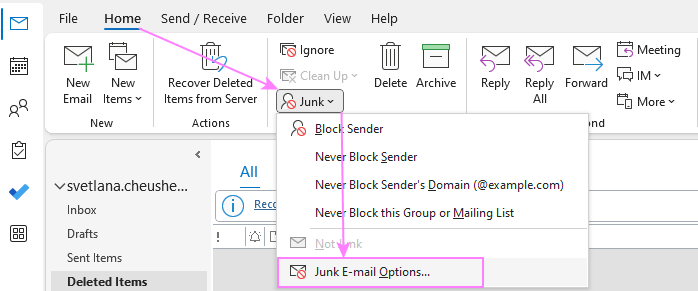
This opens the Junk E-mail Options dialog box, which is divided into 5 tabs that control various aspects of spam protection. Let’s take a brief look at each tab and focus on the essential settings.
Set junk email protection level
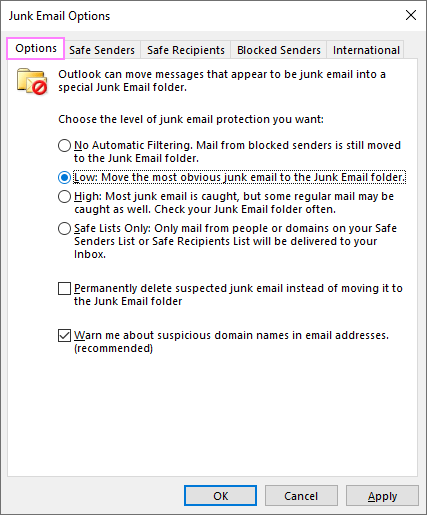
On the Options tab, you choose the desired level of spam protection:
- No Automatic Filtering — no automatic junk mail filtering, but emails from the Blocked Senders list are still moved to the Junk folder.
- Low — the most tolerant option that filters only the most obvious spam.
- High — catches most spam emails but may also misidentify legitimate messages and move them to the spam folder. If you choose this option, don’t forget to periodically review your Junk mail folder.
- Safe lists only — the maximum level of protection that only allows emails from people in the Safe Senders and Safe Recipients lists.
Besides the protection levels, two more options are available to you:
- Permanently delete suspected spam email instead of moving it to Junk folder
- Warn about suspicious domain names in e-mail addresses (available for any protection level other than No Automatic Filtering)
- It is recommended to test which option works best for you over a short period. If too much spam is still getting into your inbox, switch to the High setting. On the other hand, if too many legitimate emails such as subscribed newsletters are being mistakenly filtered as spam, switch to the Low setting.
- The Safe Lists Only option may not be the best choice as it requires manually adding safe senders to a list. Any sender not on the list will be filtered as spam, which can include legitimate emails from new clients or customers requesting quotes.
- Enabling the Permanently delete suspected junk email option leaves no chance to recover a message mistakenly treated as junk. It’s advisable to periodically check the spam folder instead of relying on this option.
Prevent good emails to be treated as junk
Using the Safe Senders and Safe Recipients tabs, you can add specific email addresses or domain names to the Safe lists. E-mail messages from anyone on these lists will never be considered spam regardless of their content.
Safe Senders List — allows you to mark email addresses and domain names as safe, preventing them from being treated as junk irrespective of the message content. However, safe domains are not automatically recognized in Exchange Online. The Safe Sender list is limited to 1024 items.
Safe Recipients List — allows you to mark mailing and distribution list senders as safe.
To add someone to your safe list, click the Add button in the right-hand part of the window, and then type an e-mail address or domain name in the pop-up dialog box.

- To trust all emails from your Contacts or automatically add people you email to the Safe Senders list, select the corresponding option on the Safe Senders tab.
- If you have an Exchange Server account, all names and email addresses in the Global Address List (GAL) are automatically considered safe.
- Another way to add a specific contact to the Safe list is to right click a message, click Junk and choose one of the options: Never Block Sender, Never Block Sender’s Domain, or Never Block this Group or Mailing List.
- You can import Safe Senders from a .txt file by clicking the Import from File… button in the right-hand part of the dialog window.
Block malicious senders
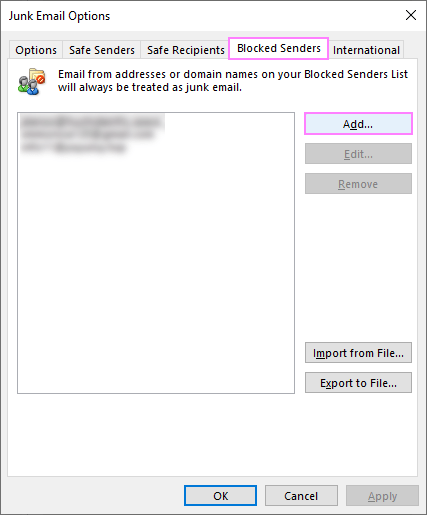
On the Blocked Senders tab, you can see email addresses that are already blocked, add more senders to the list or unblock a particular sender. All messages from blocked senders are considered spam and automatically moved to the Junk folder.
To block a sender, click the Add button, and then type an e-mail address or domain name in the pop-up dialog box.
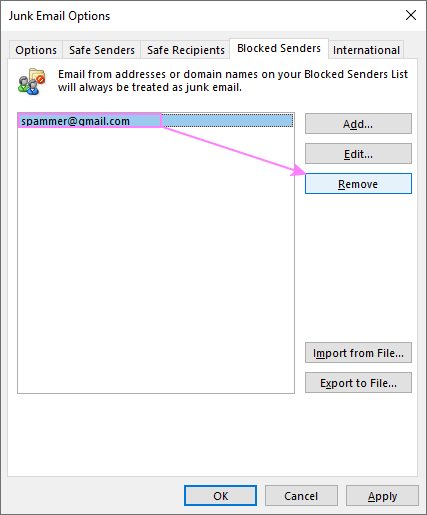
To remove someone from junk, select it in the Blocked Senders list and click the Remove button.
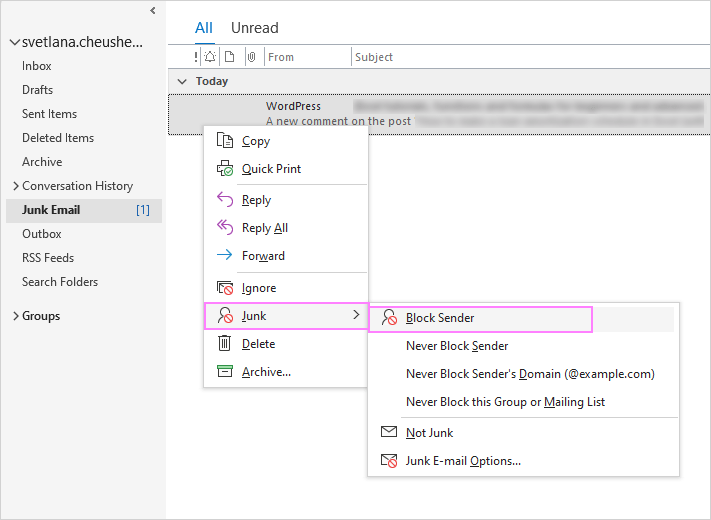
Tip. Another quick way to block a specific spammer is to right-click the message and choose Junk > Block Sender from the context menu. To remove a good contact from junk, choose Never Block Sender.
Block unwanted email from certain countries or in foreign languages
Spammers often use domains from obscure regions where domain registration is cheap. On the International tab, you can mark certain country domains as spam to stop receiving unsolicited email in foreign languages that you don’t know.
This tab provides the following two options:
Blocked Top-Level Domains List. Use this option to block emails from specific countries or regions. For example, if you select IN (India) in the list, you will stop receiving any messages from the .in domain. However, this option may not be effective against junk emails sent from popular email services like Gmail or Outlook.com.
Blocked Encodings List. Use this option to eliminate unwanted e-mail in a specific language encoding.

Note. Messages that have unknown or unspecified encodings will be filtered by the Junk E-mail Filter in the usual way.
Junk mail settings in Outlook 365 online
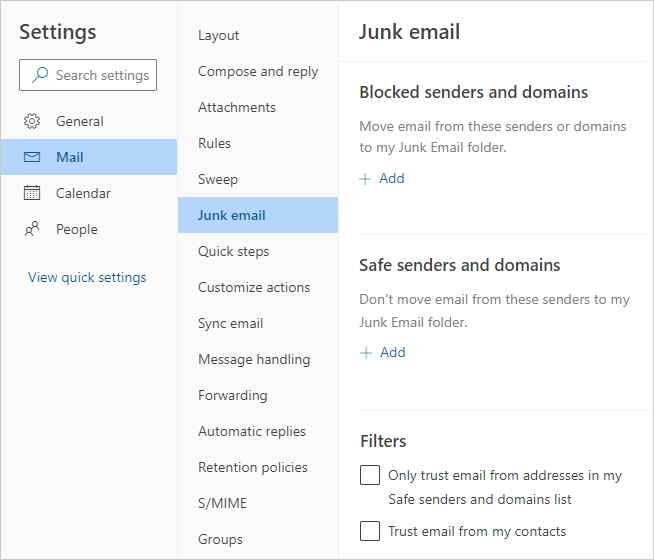
If you are using Outlook 365 as a web application (Outlook Online), then you can change junk mail settings by following these steps:
- Sign in to Outlook on the web.
- At the top of the screen, click Settings (the gear icon), then View all Outlook settings.
- In the window that opens, select Mail > Junk email.
- Add addresses to the Safe Senders and Domains or Blocked Senders and Domains lists. Change Filters and Reporting as desired.
Why Blocked Senders list is not the best way to stop junk email
While it may seem that adding unwanted senders to the Blocked list is the easiest solution to prevent spam, this method is not very effective for several reasons:
- Spammers rarely use the same email address more than once, so adding individual addresses to the Blocked list is a futile effort.
- For Microsoft Exchange Server accounts, there is a limit of 1024 addresses for the Blocked Senders list and two Safe lists combined.
- When receiving email, the first thing that Outlook does is check it against the junk filter lists. So, the longer your lists, the slower Outlook will process incoming messages.
Considering the above, the most effective approach is to keep your spam filter lists as short as possible.
However, if you are inundated with an overwhelming number of unwanted emails, you may wonder what you should do. In case numerous spam messages are sent from a particular domain, it makes sense to add it to your Blocked Senders list. To block the entire domain, there is no need to enter sub-domains or use wild characters. You can ban the whole domain by simply entering @spam-domain.com, and this will stop all junk mail coming from that domain.
Tip. Spammers are sneaky and usually send those annoying unsolicited emails from fake addresses that look nothing like the one in the From field. But don’t worry, you can try to uncover the real sender’s address by taking a peek at the internet headers of a message.
How to keep Outlook Junk Email Filter up to date
Although most spam is easily identifiable, some spammers carefully study Microsoft’s junk mail filter technology to improve their strategies. On the other hand, Microsoft works hard to combat spam and regularly updates their filter to reduce junk email. Therefore, it is advisable to update Outlook regularly to ensure the latest version of the filter is installed.
To enable automatic updates in Outlook, follow these steps:
- Start Outlook.
- On the File tab, select Office Account.
- On the right side, click Update Options > Enable Updates.

Tip. Additionally, you can receive updates for all Microsoft products when you update Windows. For this, click Start > Settings > Update & Security > Windows Security > Windows Update > Advanced Options, and then toggle on the Receive updates for all Microsoft products when you update Windows option.
How to report spam to Microsoft
Even if you have the latest version of the junk mail filter, some spam emails may still end up in your inbox. You can assist Microsoft in enhancing the efficiency of their junk email filtering technologies by reporting such messages to them.
Currently, the inbuilt Report button is only available in Outlook on the web (OWA). To report spam to Microsoft, here’s what you do:
- In Outlook on the web, select one or more unsolicited emails.
- On the top menu, click Report, and then select either Report phishing or Report junk.

In desktop Outlook, there is no built-in Report button. As an alternative, you can use free Microsoft Report Message and Report Phishing add-ins. Or you can submit a report through the Microsoft 365 Defender portal.
How to mark an email as not junk in Outlook
Legitimate emails can sometimes be mistaken as spam and moved to the Junk folder. It is important to remember to check this folder occasionally, as no filter is perfect. If you set your Outlook spam filter to the High level to prevent as much junk mail as possible, it is recommended to check your spam folder frequently. Checking it at the end of your workday is a good practice to ensure that you have covered everything.
If a legitimate message appears among junk emails, you can mark it as not junk in this way:
- Right click the message, and then click Not Junk.
- From the context menu, choose one of the options: Never Block Sender, Never Block Sender’s Domain or Not Junk.
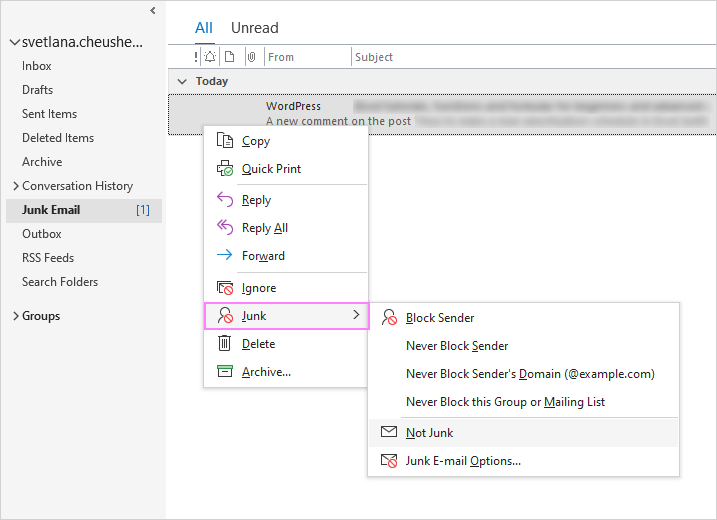
Clicking Never Block Sender or Never Block Sender’s Domain will add the sender’s address or domain name to your Safe Senders list, so the Outlook spam filter won’t make the same mistake again.
Choosing Not Junk will move the message from the Junk folder to your Inbox. Additionally, you can select the Always trust e-mail from… option to add that email address to the Safe Senders list.

If you do not wish to add a specific sender to your safe list, you can simply drag a misidentified junk message to any other folder using the mouse.
Note. Emails classified as spam and moved to the Junk folder are automatically converted to plain text format with any links disabled. When you move a message out of the spam folder, its links will be re-enabled and the original message format restored, unless the Junk E-mail filter identifies the links as suspicious. In such cases, even if you move the message out of the Junk folder, the links will remain disabled by default.
How to turn off Junk Mail Filter in Outlook
To turn off Outlook’s junk mail filter, this is what you need to do:
- In your Outlook, open the Junk E-mail Options dialog box (Home tab > Junk> Junk E-mail Options).
- On the Options tab, select No Automatic Filtering. This will stop automatic mail filtering, but messages from the Blocked Senders list will still be moved to the Junk folder.
- Review the Blocked Senders list and clear it if needed. To have it done, switch to the Blocked Senders tab, select the addresses/domains and click the Remove button.
In conclusion, spam emails can be frustrating and time-consuming to deal with, but by implementing these tips and tricks, you can successfully prevent them from infiltrating your Outlook inbox. Remember to regularly update your spam filter, block malicious domains, and always be cautious of suspicious emails. With a bit of effort and know-how, you can take control of your email and make sure that only the messages you want are making it to your inbox. Happy emailing!
You may also be interested in
Table of contents
103 comments
Hi All,
I have been getting 20+ unwanted emails every day for months and months now, it suddenly started from nowhere. No amount of spam filter settings has made any difference.
I raised the issue with Microsoft support and kept pursuing this with them whilst they were ‘investigating’. I sent them copies and examples of the spam emails as they requested. The outcome was that, this is an issue they are aware of, they ware working hard to find a fix for it, but basically there is nothing they can do for me or the many others affected — THIS IS POOR FROM MICROSOFT
I am now in the weird situation where i have to delete spam from my inbox daily, but also move legitimate emails from my junk into my inbox. Pathetic!
So for those of you looking for the solution to this issue, there might not actually be one, other than to change your primary email address to a new one — which is a total pain in the *ss.
If possible, use another mail client like Thunderbird.
I need to use Outlook because of work as Thunderbird can only be used while on VPN , but Thunderbird is soooo much better at filtering spam. Yes, you need to train it a bit with clicking on «is junk» but then it filters also similar mails and adapted ones.
So if you can switch, do it.
With the amount of spam we receive, I have set the setting to «safe senders only». The list has been populated with about 20 email addresses but we still get spam from people not on the list into the Inbox??
Great article. I’m finding that, despite changing the setting to «No automatic filtering», my Junk folder is still filled with suspected emails. And, no, there are no email addresses in my Blocked list.
Thank you.
Two things:
1. Many articles regarding this seem to be aimed at helping keep junk mail out of the inbox. I don’t really have that problem. You usually must move to the next level of filtering. I rarely get junk mail in my inbox. The problem is, getting so much junk mail that it makes it hard for one to find the occasional incorrectly filtered safe e-mail. I have mine set to the highest filtering, safe lists only. Is there no way junk email can be handled at the server level, so it never reaches me? What does Google do? I get next to nothing with that address.
2. I’ve decided that I would like the suspected junk mail to be permanently deleted. I have tried that checkmark and it just will not permanently delete (or delete in any way without my input) the junk e-mail. If I have that feature checkmarked, shouldn’t there rarely be junk mail in my junk mail folder? What is that for if it doesn’t work.? My junk mail folder fills up anyway and nothing ever gets permanently deleted.
Worrying about the junk mail folder wasn’t anything I had to do until around November of last year, 2022. I used to get 10-15 junk mail per week (I’ve had my msn.com email forever). Now I get 30 or 40 per day, or more sometimes! I was not hacked but a contact of mine was, so I’m blaming that, but I don’t really know.
Your information on the «report message» add in is out of date. You link to the old add-in which no longer functions but had much better functionality.
The new add in forwards emails as attachments (these sent emails are not kept in the «sent» folder) and then moves the email to the appropriate folder (junk or inbox depending on the report type). You can only do this one email at a time now and its slow. This add-in does not contribute to personal safe or blocked senders.
Rather than have the new add-in one can accomplish similar tasks like this:
-quick step to forward the email as attachment to these email addresses:
• For junk messages: junk@office365.microsoft.com
• For phishing scam messages: phish@office365.microsoft.com
• For a legitimate email falsely flagged as spam, address it to not_junk@office365.microsoft.com
tick automatically send after 1 minute delay
then move to the required folder (junk, inbox or whatever) or delete.
You can have a separate rule to process the sent items to these email addresses if you want.
-if you want to make sure that emails from that sender are processed properly in future for your own inbox you must add to safe or blocked senders
do this by right clicking on the email and choosing the option
using the junk options on the delete group in the main tab
or setting up custom buttons as I have done for Never block sender/domain/list and block sender
Hope that helps others!
Thank you for sharing your information, very helpful. This article was written many years ago, many descriptions are outdated and require complete rewriting — on my to-do list already.
Upd: the article is updated.
Thanks Nichole.
I’m doing just what you suggest by «Quick Step» forward. Maybe if I forward the dozens I get, it’ll help. I set it to permanently delete but then my forwarded message in in the sent folder!
So I thought I’d be smart and set up one rule to permanently delete a message in the sent folder with the subject «Fwd: spam». Doesn’t work on its own though, I have to go to «run rules». I don’t get why. If it works when I say «run» in this folder, why doesn’t it do it on its own? There are no other rules that I’ve set up.
Hi,
I just want to check if this method sending the suspected emails directly to the mentioned emails is recommended by Microsoft in any of their online learning documentation ?
Hello, your screen shots have nothing to do with my Outlook. In mine there no way to find email settings.
Could you please update your Webpage to the correct one?
Thank you for your feedback. I’ve updated the content and screenshots using Outlook 365. In all modern versions, the options are essentially the same.
To whom, I use Microsoft 2016 suite, the last 2 days I am unable send an email even to me, that will show up in my inbox. I do not know how to see who is in my junk block list.
Tim
I turned off the dialog box where I can check the email before blocking it in junk. How do I turn it back on?
Thank you for the guidance.
when I receive an email from a dotted domain name such as:s @e9gsd00d.coffeeforlife.com,
can I put the last part of the domain name (coffeeforlife.com) as the domain to be blocked. It is apparent that they can change the first part of the domain on a daily basis.
you can block any domain by outlook rules.
create new rule,
mark option «containing specific words in the domain address»
put there any domaun you like to filter.
and mark «move it to folder» for example junk or trash
Thank you for the guidance.
All the emails I receive (even from someone on the safe senders list, include *** SPAM *** in the subject line. Is there a setting I can change to remove/prevent it. It is embarrassing to reply to a business contact’s email and in the subject line it is indicated that the sender’s email is classified as spam.
Most of the emails I receive in my Inbox (not in the junk mail folder) are marked as spam. Why and how do I change it?
I think this is a particularly helpful piece of advice:
«Most often spammers send all those unsolicited emails from fake addresses, different from what you see in the From field. You can try to find the real address of the sender by looking in the Internet Headers of a message (open the message and go to the File tab > Info > Properties).»
How to prevent email automatically goes to spam in outlook 2013.
Just a smiling visitor here to share the love (:, btw great style and design. “The price one pays for pursuing a profession, or calling, is an intimate knowledge of its ugly side.” by James Arthur Baldwin.
I keep getting dozens of advertising spam from sender(s) which have an email such as «lolip19@grandmotherr.ddns.net». Every name is different but the «ddns.net» is common in all of them. I have been trying to globally junk them by using forms of «ddns.net», *.ddns.net», «*@*.ddns.net», etc. but they don’t work. How can I junk emails with this double-domain format?
After months of struggling with my boss’s sent messages ending up in the junk folder in Outlook, I am very relieved to have finally resolved the issue. The culprit was the spam filter on his Samsung (S8) smartphone! For whatever reason, it had identified his own address (and a few other trusted addresses) as spam, and no amount of tinkering with settings in Outlook had any effect. Our fix was to start using the Outlook app on his phone and disable the native email app.
Hi,
I have done all the settings as you described, still im getting spam mails in Inbox , Im totally fed up with receiving unwanted mails.
please suggest me any solution for this, Important mails are Automatically going spam folder
I`m using windows 10, 64bit operating system
I have NOT been receiving emails from all of my contacts in my address book. I hope it’s cleared up ASAP. Thanks-Chuck Huddle
Hi team, i have a question why all my sent email goes to junk not inbox but for 1email address only is it means someone block my domain or it might be happen by mistake of recipient? Other people can receive my email only 1adress receiving in junk? May i know the reason why like that? I want to know that is it done by someone who unwanted my email?