How to Install Pandas in PyCharm

As a data scientist or software engineer, you probably use PyCharm as your primary IDE to develop and run Python code. Pandas is a powerful data analysis tool that is widely used in the data science community. In this article, we will go through the process of installing pandas in PyCharm.
What is Pandas?
Pandas is an open-source data analysis and manipulation library that provides easy-to-use data structures and data analysis tools for Python. It is built on top of the NumPy library and provides fast and efficient data analysis capabilities for handling large datasets.
Pandas is widely used in data science and machine learning projects for data cleaning, data transformation, data visualization, and statistical analysis.
How to Install Pandas in PyCharm
Before installing pandas in PyCharm, make sure that you have installed Python on your system. You can download the latest version of Python from the official Python website.
Once you have installed Python, follow the steps below to install pandas in PyCharm:
Open PyCharm and create a new Python project or open an existing project.
Click on the “File” menu and select “Settings” (or “Preferences” on macOS).
In the Settings/Preferences dialog box, click on the “Project” tab, and then click on “Project Interpreter”.
In the Project Interpreter pane, click on the “+” button to add a new package.
In the “Available Packages” dialog box, search for “pandas” and select it.
Click on the “Install Package” button to install pandas.
Wait for the package to be installed. You can check the progress in the “Event Log” pane.
Once the installation is complete, you can start using pandas in your PyCharm project.
Conclusion
In this article, we have discussed how to install pandas in PyCharm. Pandas is a powerful data analysis tool that is widely used in the data science community. By following the steps outlined in this article, you should be able to install pandas in PyCharm and start using it in your data science projects.
Remember that pandas is just one of the many data analysis tools available in Python. As a data scientist or software engineer, it’s important to keep learning and exploring new tools to stay ahead in your field.
How to install Pandas in Python
Check If python is installed on your system, If yes then you should be able to get its version using command prompt:
C:\Users\dipanshuasri>python –version
Python 3.8.2

If not installed then please visit https://www.python.org/downloads/
Python Pandas can be installed on windows in 2 ways:
- Using Pip (package manager)
- Using Anaconda Navigator
Install Pandas using pip
-
Go to Windows command prompt and type :

Installation steps using Anaconda Navigator
-
Press Windows Start menu button and type Anaconda Navigator .


Then a pop up will arise to mention the list and number of packages in Pandas bundle. Click on Apply to get them installed.


Installing Python pandas on Linux
Pandas is a part of Anaconda’s distribution.
It can be installed on Linux in many ways:
-
Using pip installer package
3. Using Anaconda
Pre-Requisites :
Make sure that python is installed on your system.
For ex: Open your terminal and enter below command
Installing Pandas using pip package
It is the most easy way to install pandas package. PIP is a package management tool which is used to install and manage software packages or libraries written in python.They libraries are stored in online repository termed as Python package index i.e PyPI .
Go to Linux Terminal and enter below :
This command will install pandas onto your system.
Installing pandas using PyCharm
Pandas can be installed using Pycharm community edition.It is one of the best opensource IDE developed by jetBrains Community. To download please visit this official website link:
After installing Pycharm , Open it.
Then Go to File -> Settings
Search for Python Interpreter .

Then click + symbol on the right side of pop-up. You will get another pop-up. Now enter pandas and click Install package.

Installing pandas using Anaconda distribution
It is the most desired open source tool for Data analysis and machine learning.
First install anaconda on your system if you have not it already :
-
Go to the official site :

In my case it is present in below download section. But i would suggest you to keep it in /tmp directory or at any custom location.
$cd /Downloads

Then enter the options which it prompts according to your requirements.
At the end you will see a thanks message. Cheers you are almost done.

Verify Installation
Close your shell/terminal and open it again from same location.
You will notice a prefix(base) .

Or you can try $conda info

Conda by-default contains the pandas lib in Anaconda distribution or packages.
To verfiy it please type: $ conda list
You will get the entire list in alphabetical order.

Was this post helpful?
You may also like:
Bash Get Output from Python Script
Count Unique Values in NumPy Array
Create Array of Arrays in Python
Convert String List to Integer List in Python
Convert Object to Float in Pandas
NameError: Name requests Is Not Defined
Python Hex to String
NameError: Name xrange Is Not Defined in Python
Call Python Script from Bash with Arguments
TypeError: ‘dict_values’ Object Is Not Subscriptable
Share this
How to get frequency counts of a column in Pandas DataFrame
Pandas convert column to float
Related Posts
Author
I am a technology enthusiast and a seasoned coder. Being a full stack developer , i have an insatiable quest to learn new technologies. I have experience in Java , Spring Boot , Web Services , Hibernate , Angular and React.js and much more .I am a prolific writer and poet. I love to do yoga and exercise to keep myself fit.
Related Posts

Convert Object to Float in Pandas
Table of ContentsUsing astype() MethodUsing to_numeric() Method Using astype() Method Use the astype() method to convert one DataFrame column from object to float in pandas. [crayon-64f6ae9a1e154541824849/] [crayon-64f6ae9a1e15c020378754/] Use the astype() method to convert multiple DataFrame s from object to float in pandas. [crayon-64f6ae9a1e15e582014060/] [crayon-64f6ae9a1e160794131924/] Use the astype() method to convert the entire DataFrame from object […]

Remove All Non-numeric Characters in Pandas
Table of ContentsUsing Pandas Series.str.extract() MethodUsing Series.str.replace() MethodUsing re.sub() with apply() MethodUsing lambda Function Using Pandas Series.str.extract() Method To remove all non-numeric characters from one column in pandas: After creating the data frame, use the Series.str.extract() method to extract numeric parts. [crayon-64f6ae9a1e54b233106841/] [crayon-64f6ae9a1e552604596221/] In this code, we used the Series.str.extract() method to extract numeric parts […]
Convert Pandas Dataframe Column to List
Table of ContentsUse Series.values.tolist() MethodUse list() MethodConclusion Use Series.values.tolist() Method To convert pandas dataframe column to list: Use pd.DataFrame() to read position_salaries as a pandas data frame. Use df["Position"] to get the column position from df Use position.values to get values of the position Use position_values.tolist() to get list of position_values as position_list [crayon-64f6ae9a2008c077647193/] The […]

Pandas apply function to column
Table of ContentsHow do I apply function to column in pandas?Using dataframe.apply() functionUsing lambda function along with the apply() functionUsing dataframe.transform() functionUsing map() functionUsing NumPy.square() function We make use of the Pandas dataframe to store data in an organized and tabular manner. Sometimes there, is a need to apply a function over a specific column […]

Find rows with nan in Pandas
Table of ContentsWhat is nan values in Pandas?Find rows with NAN in pandasFind columns with nan in pandasFind rows with nan in Pandas using isna and iloc() In this post, we will see how to find rows with nan in Pandas. What is nan values in Pandas? A pandas DataFrame can contain a large number […]
Pandas replace values in column
Table of ContentsUsing the loc() function to replace values in column of pandas DataFrameUsing the iloc() function to to replace values in column of pandas DataFrameUsing the map() function to replace values of a column in a pandas DataFrameUsing the replace() function to replace values in column of pandas DataFrameUsing the where() function to replace […]
How to Install Pandas in Pycharm? : Only 4 Steps

Pandas is an open-source python library that allows you to do manipulation mostly on numeric tables, and columns. You can manipulate the CSV data, time-series data, and e.t.c. using it. It is the most used library in machine learning and deep learning. But as a beginner, you will find difficulty in installing Pandas Library in Pycharm. Therefore I have come up with the step by step guide to install Pandas in Pycharm. You will know how to install pandas in Pycharm and how to check the version of it.
Let’s assume the case when you type import pandas as pd. Then you will see the underline error like this. It means you have not installed the panda’s packages. You have to install it before continuing to use it. You will get like this. And if you try to run the program then you will get a No Module named pandas found error. It means the pandas Python package is not installed on your system.
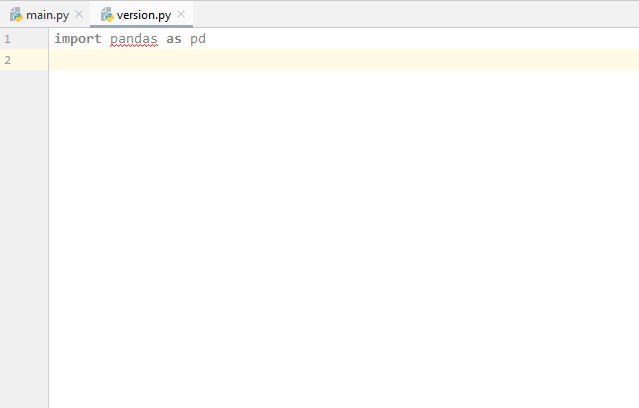
How to Install Pandas in Pycharm?
Step 1: Go to File and click Setting. You will see the windows with so many options to click.
Step 2: Click on the Project. You will find two options Project Interpreter and Project Structure. Click on the Project Interpreter.
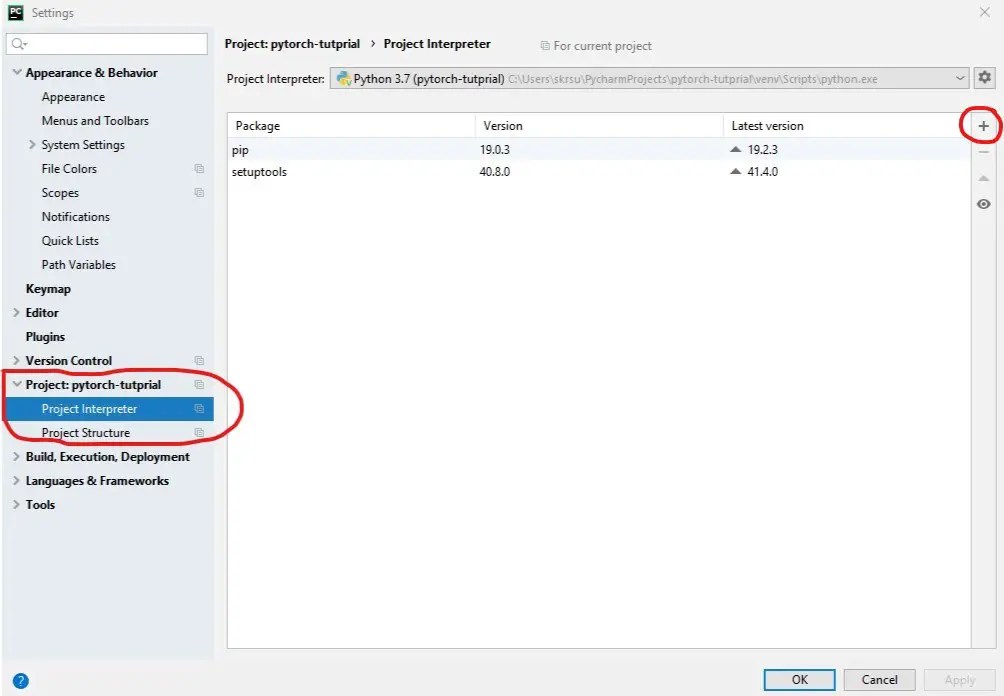
Step 3: You will see the list of all the packages that are already installed. Click on the “+” sign that is in the right of the window and search for the Pandas.
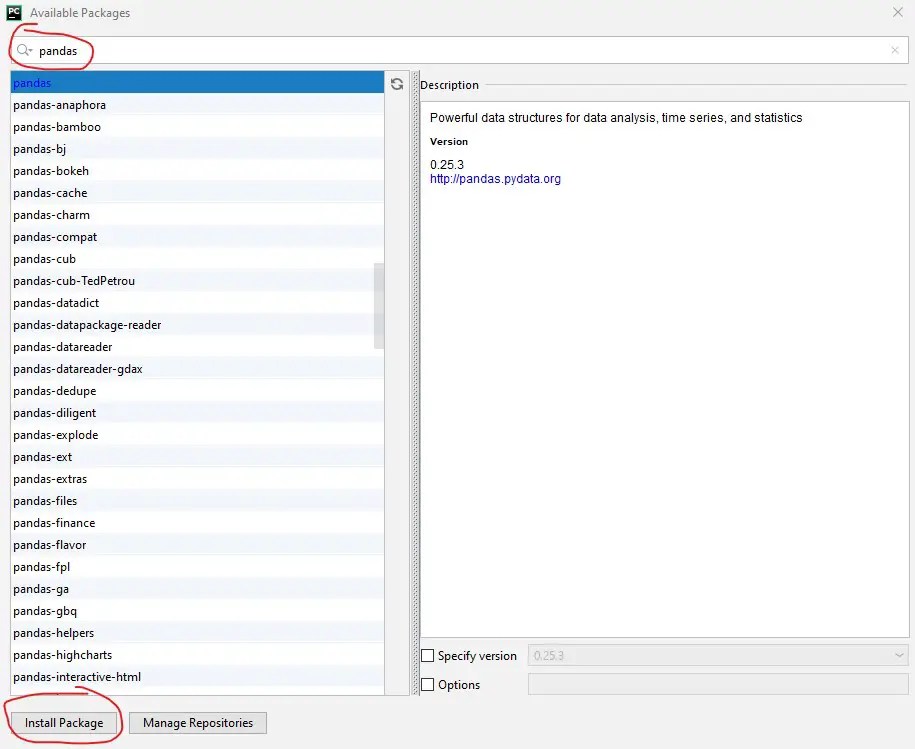
Step 4: Select the Package with the named Pandas ( https://pandas.pydata.org/) and click on the Install Package.
You have successfully installed Pandas and there will be no error.
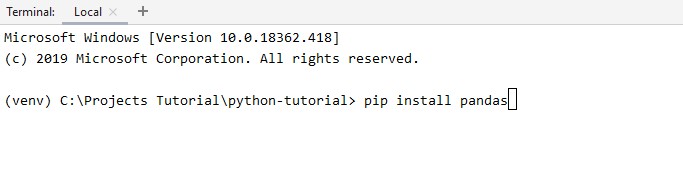
Sometimes installing with the above steps gives the error ” Error occurred when installing Package pandas“. Then you have to install using the terminal of the Pycharm. Click on the terminal available below. and type the following command.
This will install the packages successfully.
But in case you are using python 3.xx version then you have to install pandas using the pip3 command.
How to check the version of Pandas?
To check the version of the pandas installed use the following code in Pycharm.
Output
Even after following all the steps given here, you are unable to install pandas in Pycharm then you can contact us for more help. You can also message to our official Data Science Learner Facebook Page.
Errors Handling
In this tutorial, many of our readers have contacted us for solving errors and one of them is “No module name Cython“. Below is its screenshot.
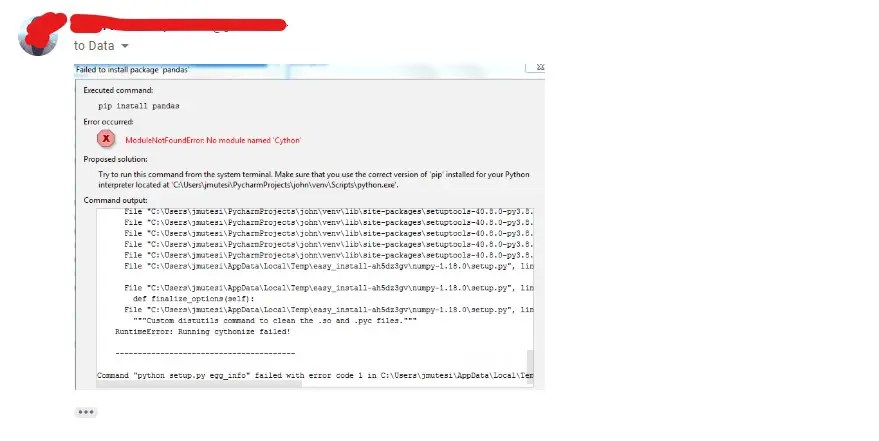
If you are getting the same problem then you have to install first Cython and then install pandas. This will solve the problem. To install it run the below command for your specific python version.
Other Questions Asked by the Readers
Q: I am getting no module named pandas in pycharm. How to solve this problem?
If you getting no module named pandas error in your Pycharm then it’s a high probability that you have not installed pandas properly in Pycharm. To remove this error carefully follow all the above steps. It will solve this problem.
Q: Getting nameerror name pd is not defined Error
Many data science learner readers have asked even if they have installed pandas they are getting nameerror name pd is not defined error. We want to tell them that you are not properly importing the pandas package. There can be a typo mismatch while you are importing pandas.
Verify it. You will not see this error.
Please contact us if you are getting another problem while installing the pandas module.
- Total 18
Join our list
Subscribe to our mailing list and get interesting stuff and updates to your email inbox.
We respect your privacy and take protecting it seriously
Thank you for signup. A Confirmation Email has been sent to your Email Address.
How to install pandas in pycharm
I am trying to install the pandas package in pycharm. I get the following error: unable to find vcvarsall.bat (i tried to install via the cmd but also via the project interpreter ). I tried to install WSDK according to here but it did not work. I also tried the instructions in the video. Lastly i tried downloading the gcc binary according.
None of these worked. Any ideas ? I am using Windows 10, my python version is 3.4.1 and the pip version is 1.5.6 (for 64-bit)
6 Answers 6
Try python -m pip install —upgrade pip followed by pip install pandas , or python -m pip install pandas .
If you are on latest PyCharm 2018 then follow the below steps to install:
Click on PyCharm shown on the Menu bar -> Click Preferences -> Click Project Interpreter under your Project -> Click ‘+‘ -> search for ‘pandas’/’numpy’ (you can specify specific version you want to install) and Click install underneath. Now you’re done.

Open terminal from View -> Tool Windows -> Terminal type command:
Upon successful installation you should see output like so:
Then from File → Settings → Project: YourProjectName → Project Interpreter check that under project interpreter pandas package installed.


Easiest way to do this is install anaconda on your machine. Then fire up your pycharm >> go to new project >> then you are given with 2 option — one is to select folder and the second one is to select interpreter .
Select interpreter as the directory where you have installed anaconda then go to settings, there you find something available packages then search for the package you wish you install and press install package and you are good to go.
This is the list you will get , just click on the one you want to install and hit install package at the bottom of dialog box.

Just write your program, use pandas library. import pandas -> under pandas you will see red lines. Hover your mouse there you will see install option just click it and wait for few minutes.