Error function
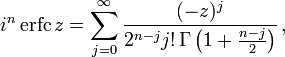
The complementary error function, denoted erfc, is defined in terms of the error function:
The complex error function, denoted w(x), (also known as the Faddeeva function) is also defined in terms of the error function:
Contents
Properties [ ]
Also, for any complex number x one has
The error function at infinity is exactly 1 (see Gaussian integral ).
The derivative of the error function follows immediately from its definition:
The inverse error function has series
where c0 = 1 and
So we have the series expansion (note that common factors have been canceled from numerators and denominators):
(After cancellation the numerator/denominator fractions are entries A092676/A132467 in the OEIS; without cancellation the numerator terms are given in entry A002067.)
Plot of the complementary error function
Note that error function’s value at plus/minus infinity is equal to plus/minus 1.
Applications [ ]
The error and complementary error functions occur, for example, in solutions of the Heaviside step function .
Asymptotic expansion [ ]
A useful asymptotic expansion of the complementary error function (and therefore also of the error function) for large x is
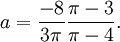
This series diverges for every finite x. However, in practice only the first few terms of this expansion are needed to obtain a good approximation of erfc(x), whereas the erf 2 ( x ) ≈ 1 − exp ( − x 2 4 / π + a x 2 1 + a x 2 ) <\displaystyle \operatorname
Related functions [ ]
The standard normal cdf is used more often in probability and statistics, and the error function is used more often in other branches of mathematics.
The error function is a special case of the Mittag-Leffler function , and can also be expressed as a e r f ( x ) = 2 x π 1 F 1 ( 1 2 , 3 2 , − x 2 ) . <\displaystyle \mathrm
Some authors discuss the more general functions
Notable cases are:
- E0(x) is a straight line through the origin: E 0 ( x ) = x e π <\displaystyle E_<0>(x)=<\frac
- E2(x) is the error function, erf(x).
After division by n!, all the En for odd n look similar (but not identical) to each other. Similarly, the En for even n look similar (but not identical) to each other after a simple division by n!. All generalised error functions for n>0 look similar on the positive x side of the graph.
These generalised functions can equivalently be expressed for x>0 using the Gamma function:
Therefore, we can define the error function in terms of the Gamma function:
Iterated integrals of the complementary error function [ ]
The iterated integrals of the complementary error function are defined by
They have the power series
from which follow the symmetry properties
Implementation [ ]
C/C++: It is provided by C99 as the functions double erf(double x) and double erfc(double x) in the header math.h or cmath. The pairs of functions <erff(),erfcf()> and <erfl(),erfcl()> take and return values of type float and long double respectively. GCC makes these functions available in C++ too.
Erf это что в математике

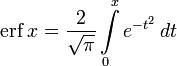
is the "error function" encountered in integrating the normal distribution (which is a normalized form of the Gaussian function). It is an entire function defined by
Note that some authors (e.g., Whittaker and Watson 1990, p. 341) define without the leading factor of .
Erf is implemented in the Wolfram Language as Erf[z]. A two-argument form giving is also implemented as Erf[z0, z1].
Erf satisfies the identities
where is erfc, the complementary error function, and is a confluent hypergeometric function of the first kind. For ,
Erf can also be defined as a Maclaurin series
For , may be computed from
(OEIS A000079 and A001147; Acton 1990).
and continuing the procedure gives the asymptotic series
Erf has the values
and the integral is
Erf can also be extended to the complex plane, as illustrated above.
A simple integral involving erf that Wolfram Language cannot do is given by
(M. R. D’Orsogna, pers. comm., May 9, 2004). More complicated integrals include
(M. R. D’Orsogna, pers. comm., Dec. 15, 2005).
(Wall 1948, p. 357), first stated by Laplace in 1805 and Legendre in 1826 (Olds 1963, p. 139), proved by Jacobi, and rediscovered by Ramanujan (Watson 1928; Hardy 1999, pp. 8-9).
Definite integrals involving include Definite integrals involving include
The first two of these appear in Prudnikov et al. (1990, p. 123, eqns. 2.8.19.8 and 2.8.19.11), with , .
Интеграл вероятности

![\operatorname<erf>^<-1>\,x=\frac<1><2>\sqrt<\pi>\left (x+\frac<\pi x^3><12>+\frac<7\pi^2 x^5><480>+\frac<127\pi^3 x^7><40320>+\frac<4369\pi^4 x^9><5806080>+\frac<34807\pi^5 x^<11>><182476800>+\dots\right ). \,\!» width=»» height=»» />[1] </p>
<p>Последовательности числителей и знаменателей после сокращения — A092676 и A132467 в OEIS; последовательность числителей до сокращения — A002067 в OEIS.</p>
<h3>Применение</h3>
<p>Если набор случайных чисел подчиняется нормальному распределению со стандартным отклонением σ , то вероятность, что число отклонится от среднего не более чем на <i>a</i> , равна <img decoding=](https://dic.academic.ru/pictures/wiki/files/48/0ccb9eb82f9a432fb7a3417fd4162bf8.png)
![\operatorname<erfc>\,x = \frac<e^<-x^2>><x\sqrt<\pi>>\left [1+\sum_<n=1>^\infty (-1)^n \frac<1\cdot3\cdot5\cdots(2n-1)><(2x^2)^n>\right ]=\frac<e^<-x^2>><x\sqrt<\pi>>\sum_<n=0>^\infty (-1)^n \frac<(2n)!><n!(2x)^<2n>>.\,» width=»» height=»» /></p>
<p>Хотя для любого конечного <i>x</i> этот ряд расходится, на практике первых нескольких членов достаточно для вычисления <img decoding=](https://dic.academic.ru/pictures/wiki/files/50/2d5fe0b0f05b66753a4dc4d68612c2e1.png)



 $$\operatorname